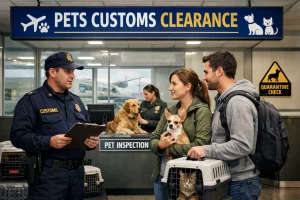
Relocating your dog from the Netherlands to Malaysia sounds simple until you hit the fine print: MAQIS import permit, DVS health rules, an IATA -compliant travel crate, and flight routes that won’t accept pets in the hold on certain aircraft. The good news? If you build a clear timeline and book the right routing, the move can go smoothly (most problems come from “last-week” planning).
Quick checklist (save this)
You’ll usually need:
- ISO microchip (11784/11785) implanted and recorded
- MAQIS import permit (required before travel)
- Veterinary Health Certificate (VHC) issued within 7 days of export
- Rabies vaccination + rabies antibody (titre) test meeting Malaysia’s threshold for non-scheduled countries (common category for many countries outside the “scheduled” list)
- Parasite treatments (internal + external) 2–7 days before export
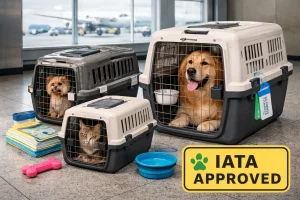
- IATA-compliant crate sized correctly (details below)
- Arrival plan for inspection + potential quarantine (varies by country category)
Step 1: Confirm Malaysia entry rules for your dog (breed + country category)
1) Breed restrictions matter (seriously)
Malaysia’s import protocol lists restricted breeds (allowed only with extra approval) and banned breeds (not allowed). Examples include restricted: Bull Mastiff, Bull Terrier, Doberman, German Shepherd/Alsatian types, Perro de Presa Canario, Rottweiler; and banned: Akita, American Bulldog, Dogo Argentino, Fila Braziliero, Japanese Tosa, Neapolitan Mastiff, Pit Bull types.
If your dog falls into a restricted category, you’ll need additional written approval before you even apply for the permit.
2) Netherlands is typically treated as “non-scheduled” under the DVS protocol list
Malaysia’s DVS protocol groups exports into “scheduled rabies countries” (a short list) and non-scheduled (most other countries).
For many non-scheduled cases, Malaysia requires a rabies vaccine + titre test and may impose quarantine (more on that below).
Step 2: Build a realistic timeline (don’t try to compress it)
Malaysia’s DVS protocol for non-scheduled countries includes timing that you can’t fake:
- Rabies vaccine must be done early enough (Malaysia’s protocol references at least 3 months prior for the rabies requirement section).
- The rabies antibody (titre) test sample must be taken at least 1 month after vaccination, and within 6 months prior to export, with a protective titre of 0.5 IU/ml or more, tested at an OIE-approved lab.
- The health certificate must be issued within 7 days of export.
- Parasite treatments must be done 2–7 days before export.
Simple timeline table (example)
|
When |
What you do |
Why it matters |
|
Week 0 |
Implant/confirm ISO microchip |
Microchip is required and must match all docs |
|
Weeks 0–1 |
Rabies vaccination (if not current) |
Required for entry pathway |
|
1+ month after rabies jab |
Do RNATT/titre test |
Must hit ≥0.5 IU/ml |
|
2–4 weeks before flight |
Apply for MAQIS import permit |
Permit required before travel |
|
7 days before flight |
Vet exam + Veterinary Health Certificate |
Must be within 7 days |
|
2–7 days before flight |
Flea/tick + worming treatments |
Timing is strict |
|
Travel day |
Fly on pet-friendly routing + crate labels |
Avoid aircraft/layover issues (see routing) |
|
Arrival |
Inspection + possible quarantine process |
Quarantine duration depends on category |
Step 3: Crate rules (IATA sizing + airline “real world” rules)
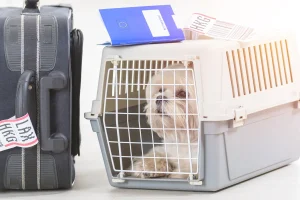
Your crate is not just “a box”. Airlines and border officers want an IATA-compliant container with correct size, ventilation, and secure construction.
1) Get the size right (IATA formula)
IATA’s public guidance gives the minimum internal dimensions for a single animal:
- Length = A + ½B
- Width = C × 2
- Height = D + bedding
- Snub-nosed breeds need ~10% larger container
If your crate is too small, the airline can reject it at check-in even if your paperwork is perfect (happens a lot).
2) Construction rules you should follow
Most airlines require:
- Dog must stand, turn around, sit upright, and lie naturally
- Solid roof, strong door, and proper ventilation (international travel often expects ventilation on multiple sides)
- For plastic kennels, many carriers require metal nuts & bolts (not plastic clips)
- Absorbent bedding, “Live Animal” labels, and a water setup (some prefer bowls that fill from outside)
Small tip that saves stress: start crate training early. Put treats inside, feed meals there, and let your dog nap in it. Otherwise, the crate becomes a panic box on flight day.
Related Articles:
» How do I prepare my pet for international relocation?
» Moving a cat from Netherlands to USA: stress reduction + paperwork checklist
» Moving a Dog from the Netherlands to Norway: Crate Rules, Airline Routing, and Arrival Steps
» Pet Shipping from UAE to Spain: Documents, Timeline, and Cost Factors
» Netherlands to USA Pet Relocation Step-by-Step Guide (Dogs & Cats)
Step 4: Airline routing from Amsterdam (NL) to Kuala Lumpur (MY)
For Netherlands → Malaysia, you’ll usually route via a major hub (or sometimes direct if available at the time). What matters most is not the “fastest” flight—it’s the pet-safe flight.
Choose routing that reduces risk
Aim for:
- Fewer connections (each transfer adds handling + delay risk)
- Moderate layovers (not too short, not too long)
- Flights that accept pets in hold/cargo on that aircraft type
- Cooler travel windows when possible (heat + stress adds risk)
Example: KLM-style routing rules (why they matter)
KLM publicly states key limits such as:
- No pets in hold if transfer time is more than 3 hours (with an exception via Paris requiring at least 4.5 hours)
- Pets cannot travel in the hold on certain aircraft like Boeing 787-9/787-10 and Airbus A321neo on KLM flights
Even if you don’t fly KLM, this shows the kind of rule you must check for any airline: aircraft type limits, layover windows, and “cargo only” destinations depending on local authority rules.
Practical booking tips
- Book your ticket first, then add your pet immediately (pet space is limited).
- Avoid self-transfer itineraries (two separate tickets). If your first flight is delayed, the second airline won’t care.
- Ask the airline: “Will my dog travel as checked baggage (AVIH) or manifest cargo on this route?” Some routes force cargo.
Step 5: Arrival steps in Malaysia (what happens after landing)
On arrival, Malaysia requires the correct paperwork and may place the dog into quarantine depending on classification and risk.
What officers will check
Expect checks for:
- MAQIS import permit
- Veterinary Health Certificate within 7 days
- Microchip number matches all papers
- Rabies vaccination + titre test results for the required pathway
- Parasite treatments timing and active ingredients listed
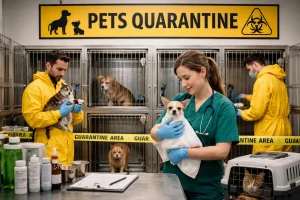
Quarantine: plan for it even if you “hope not”
Malaysia’s portal states quarantine may apply and the duration can vary by country.
Meanwhile, the DVS protocol for non-scheduled countries states the dog may be detained in quarantine for not less than 14 days, and authorities can extend it based on risk assessment.
So if you’re moving from the Netherlands under a non-scheduled pathway, plan your life like quarantine will happen. It’s better to be ready than shocked.
Common mistakes (that cause delays or extra fees)
- Crate too small or not properly bolted (airline rejects it)
- Health certificate issued too early (must be within 7 days)
- Parasite treatments done outside the 2–7 day window
- Titre test timing wrong (must be at least 1 month after vaccination and within the stated window)
- Booking a “cute cheap” route with long layovers or restricted aircraft (pet can’t fly that segment)
FAQs: Netherlands → Malaysia dog move
Yes. Under Malaysia’s protocol, a valid import permit from MAQIS is required prior to entry.
Yes. Malaysia needs an ISO-standard microchip (11784/11785) a which is recorded in the documents.
For many non-scheduled pathways, Malaysia’s DVS protocol includes a rabies antibody test with ≥0.5 IU/ml and specific timing.
It varies by category. The DVS protocol for non-scheduled countries states quarantine not less than 14 days, and it can be extended based on risk.
Malaysia’s protocol says the Veterinary Health Certificate should not be more than 7 days old from its issuance to export.
Malaysia’s protocol lists treatments as taking place 2 to 7 days prior to export, active ingredients and dates should be included on the certificate.
Use IATA sizing guidance: Length = A + ½B, Width = C×2, Height = D + bedding (and go bigger for snub-nosed breeds).
Usually only very small dogs qualify for cabin, and airline cabin rules are strict (size/weight/class restrictions). For example, KLM limits cabin pets by carrier dimensions and weight.
Pick fewer connections, avoid restricted aircraft, and keep layovers in a safe window. Airlines may reject pets in hold when layovers exceed certain limits (example: KLM’s 3-hour rule).
Yes. Malaysia’s protocol consists of banned breeds (e.g., Akita, Pit Bull types, Dogo Argentino, etc.) and restricted breeds requiring additional clearance.
It depends on airline policy and sometimes local authority handling at destination. Some airlines note that certain destinations only allow pets as cargo.
Officers verify your import permit, VHC, microchip, vaccines/tests, and treatment records. Then they guide you through release or quarantine processing depending on category.