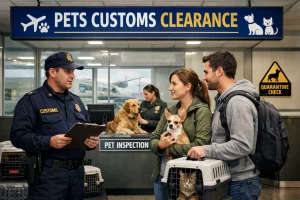
Shipping a pet over the Atlantic can be quite hard. Still, if you break it into simple steps, Netherlands to USA pet relocation becomes very doable. In this guide, I’ll walk you through a practical timeline, the paperwork, airline prep, and arrival tips for dogs and cats—without the fluff.
One quick thing first: U.S. dog import rules changed in 2024.Starting on August 1, 2024, the CDC Dog Import Form is needed for dogs entering the U.S.
Step 1: Confirm your route + entry city (and don’t skip this)
Before you book anything You need to make a decision:
- Entry airport in the U.S.(e.g., JFK, LAX, ORD, ATL,JFK)
- Need to decide if your pet is shipping through in-cabin,manifest cargo, or checked baggage
- Whether you will transit through another country (transit rules can change requirements)
The CDC usually says that the Netherlands is free of dog Rabies or at low risk.The CDC only talks about countries that are really dangerous. The CDC believes a country is low-risk or doesn’t have dog rabies if it’s not on the list. Sending a pet through a country with a lot of risk might make things harder very soon.
Step 2: Microchip first (then vaccines)
The CDC insists that dogs that arrive in the U.S.must need a microchip. Do this early since time is important. Many authorities demand the chip to be put in before the rabies vaccine gets given (and EU guidance usually follows that order).
Step 3: Rabies vaccination plan (dogs: must; cats: strongly recommended)
For dogs (Netherlands → USA)
Under the CDC’s updated rules, dogs must meet entry requirements including the form, microchip, appearing healthy, and a minimum age requirement (commonly referenced as 6 months in guidance summaries).
For dogs that have only been in dog rabies-free or low-risk countries for the last 6 months, CDC states the CDC Dog Import Form may be the only form required.
For cats (Netherlands → USA)
At the federal level, CDC says cats are not required to have proof of rabies vaccination to enter the U.S., but CDC recommends vaccination and local destinations can add rules.
USDA APHIS also notes it has no animal health requirements for importing a pet cat into the U.S., while other agencies/states may still apply requirements.
Real-world tip: airlines and many U.S. states still expect rabies documentation for cats, so in practice you should treat rabies vaccination as “basically required” for smooth travel, even if federal rules don’t demand it.
Step 4: Build a simple relocation timeline (works for most moves)
|
When to start |
What to do |
Why it matters |
|
8–10 weeks before |
Choose airline/route, confirm pet travel type (cabin/hold/cargo) |
Pet slots are limited and rules vary |
|
6–8 weeks before |
Microchip + rabies vaccination review |
Align IDs + vaccine records early |
|
4–6 weeks before |
Start crate training + practice calm stays |
Less stress, fewer travel issues |
|
2–3 weeks before |
Gather documents + contact NVWA if legalization is needed |
Some countries require NVWA legalization |
|
1–2 weeks before |
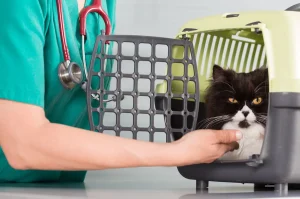
Vet visit planning for health certificate (airline timing) |
Many airlines want a recent exam |
|
0–3 days before |
Submit CDC Dog Import Form (dogs) + print/save receipt |
You must show the receipt |
Step 5: Paperwork checklist (Dogs vs Cats)
Dogs (most common Netherlands → USA set)
- CDC Dog Import Form receipt (mandatory from Aug 1, 2024)
- Microchip number recorded everywhere
- Rabies vaccination record (even if low-risk pathway simplifies paperwork, you still want proof)
- Airline-required fit-to-fly / veterinary certificate (varies by airline)
- Destination state paperwork (state rules differ; CBP reminds travelers that state/municipal regulations may apply)
Cats (typical set)
- Airline health form / recent vet exam (varies)
- Rabies vaccination proof (strongly recommended; some states require it and CDC recommends it)
If you’re leaving the EU and a destination requires extra documents, the Netherlands’ authorities note you may need special certificates signed by an NVWA vet, and in some cases NVWA must legalise documents.
Step 6: Pick the right crate (this prevents 80% of “day-of-flight” drama)
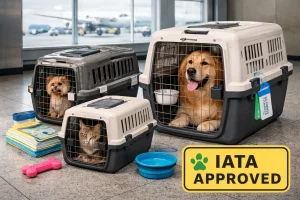
Airlines commonly follow IATA Live Animals Regulations standards for safe transport.
That means:
- Hard-sided crate for cargo/hold (many carriers require rigid crates)
- Ventilation on multiple sides
- Secure door/locks
- Absorbent bedding (no straw)
Without consulting a vet, you should not give a sedative to pets. Many airlines reject sedated pets, and it can increase risk at stature. (Airline policies will be different, so you always need to check the exact carrier rules).
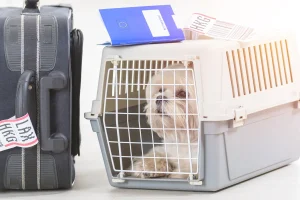
If your pet flies in the cabin, carriers impose strict size/weight limits. For example, KLM notes a max soft carrier size and a combined weight limit for pet + carrier in cabin (rules depend on cabin class and route).
Keyword you’ll see everywhere: IATA approved pet crate.
Step 7: Book the flight the “pet-friendly way”
A few things make travel smoother, honestly:
- Choose fewer connections (direct is best)
- Avoid extreme heat/cold seasons when possible
- Book early and call the airline—pet slots can sell out fast
- Ask if your entry airport has any special pet handling procedures
If your pet must travel as cargo, consider using a professional pet shipping provider who knows airline cargo systems and documentation workflows. (Not mandatory, but it reduces risk if you’re new to this.)
Step 8: Day-of-travel checklist (simple but important)
- Freeze water overnight in the bowl (it melts slowly instead of spilling)
- Tape a document pouch to the crate: copies of vaccine record + your contact details
- Put “LIVE ANIMAL” labels if airline requires (many do)
- Arrive earlier than normal (pet check-in takes time)
- Before check-in the dog need to go a short walk
Step 9: Arrival in the U.S. (what actually happens)
After the arrival, your pet will be visually inspected. If officials see signs of illness, they can require further examination at your cost (this is discussed in veterinary travel guidance).
For dogs, be ready to show your CDC Dog Import Form receipt.
For cats, you may not need federal rabies proof, but you can still be asked about health status and you must meet any state or local rules.
Step 10: After arrival (first 72 hours)
Your pet will feel “off” at first. That’s normal.
- Offer small meals (don’t push a big dinner right away)
- Keep water available
- Keep the environment quiet
- Resume normal routine(slowly)
- If your pet vomits continuously,looks like very weak, or risk to breathe, consider a vet without delay
FAQs: Netherlands → USA Pet Relocation
Yes.from August 1, 2024 The CDC Dog Import Form will be needed for all dogs which are entering the U.S.
The CDC only mentions countries that are at high risk. If a country isn’t on the list, the CDC believes it doesn’t have rabies or is at low risk.
Federally, CDC says cats don’t need proof of rabies vaccination, but CDC recommends vaccination and local rules can apply.
USDA APHIS states it has no animal health requirements for importing pet cats into the U.S., though other requirements may apply.
A lot of airlines require a health certificate and they make their own schedules, which are normally a few days before the trip. Always check your airline’s rules for pets.
CDC requires dogs to be microchipped. Use a consistent, scannable chip and make sure the number appears on every document.
Sometimes, if your dog is small enough and meets carrier limits. Airlines publish exact size/weight rules (example: KLM provides in-cabin carrier limits).
Yes,Most airlines follow the IATA Live Animals Regulations for safety and crate criteria.
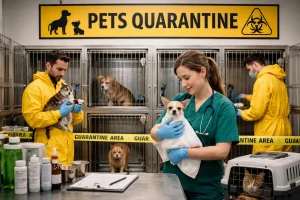
Typically not for compliant entries; quarantine concerns mainly arise when requirements aren’t met or if the animal appears ill.
Yes, states and municipalities can add more criteria. CBP says that imports can also be subject to state and municipality laws.
Sometimes. NVWA states that for travel outside the EU, NVWA may need to legalise EU pet passports and other documents in certain cases. 1
Ideally 8–10 weeks before departure, especially if you need cargo space, documents, or crate training.