What is airport-to-airport pet shipping?
Airport-to-airport pet shipping means your pet travels by air from an origin airport to a destination airport. You handle transport to the airport at departure, and you handle pickup and transport from the arrival airport to your home.
Your pet flies between two airports; you handle pickup and delivery at both ends
We support the planning and compliance. However, you (or your trusted person) will:
Drop your pet at the origin airport cargo/animal facility (or airline counter if permitted)
Pick up your pet at the destination airport after clearance
Arrange local transport on both sides
Best for: faster timelines, lower cost than door-to-door, experienced pet owners
Airport-to-airport is best if you:
Want a lower cost option than door-to-door
Can manage airport drop-off and pickup times
Prefer direct control over your pet’s local transport
Need a faster timeline (where route rules allow)
Airport-to-Airport vs Door-to-Door Pet Relocation
Both services can be safe. The difference is responsibility.
When airport-to-airport is the better choice
Choose airport-to-airport if:
You can do airport drop-off and pickup without stress
Your destination is relatively straightforward (or you already know the rules)
You want to reduce total cost
You want a quicker booking process (again, depending on permits/tests)
When door-to-door is safer or easier
Door-to-door is often better if:
You are moving with kids, luggage, and 50 things at once
You cannot manage airport cargo terminals and timings
Your route is strict or paperwork-heavy
You want one team handling the full journey end-to-end
Key differences: cost, handling, documentation, and responsibilities
Here’s a simple comparison:
| Item | Airport-to-Airport | Door-to-Door |
|---|---|---|
| Cost | Usually lower | Usually higher |
| Who handles local transport | You | Pet relocation team |
| Airport processes | Shared (you + us) | Mostly handled for you |
| Best for | Experienced owners, tight budgets | Busy moves, strict routes |
| Risk of missed pickup windows | Higher (if you’re late) | Lower (managed by team) |
What’s Included in Our Airport-to-Airport Service
We focus on the parts that decide success: compliance, crate, booking support, and coordination.
Route planning and airline-compliant booking support
We guide the route based on:
Airline pet policies (cargo vs baggage)
Seasonal temperature rules
Direct vs transit risks
Breed restrictions and crate requirements
Document checklist and timeline guidance
You get a destination-based checklist, with dates. This prevents “Oops, we forgot the waiting period” problems.
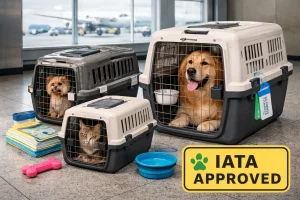
IATA-compliant crate selection and sizing help
We help you choose the correct IATA-approved pet crate size and setup, based on your pet’s measurements.
Pre-flight health check preparation
We guide you on:
When to schedule the vet visit
How to prepare for the health certificate window
What details must match (microchip number, dates, stamps)
Export/Import assistance and airport handling coordination
We coordinate the flow and timing with airport handling partners (where applicable), and guide how to present paperwork at the terminal.
Customs clearance support (where available)
In some locations, customs clearance support is possible. In others, you may need to visit the office yourself. Either way, we tell you the steps clearly.
How Airport-to-Airport Pet Shipping Works
Step 1: Share pet details (breed, size, weight, destination, dates)
You share:
Dog/cat, breed, age
Weight and measurements
Origin + destination airport/city
Preferred travel dates (or flexibility window)
Step 2: Confirm airline rules and route (direct vs transit)
We review:
Which airlines accept your pet type/breed
Whether transit is allowed (and safe)
Temperature embargo periods
Cargo terminal requirements
Step 3: Documents + vet visit scheduling
We provide a document plan (what, when, and who signs). You book the vet visits at the right time.
Step 4: Crate setup and crate-training tips
We help with crate choice and setup, plus simple training steps so your pet doesn’t panic on travel day.
Step 5: Drop-off at origin airport (what to bring)
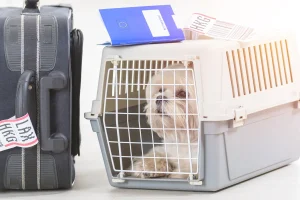
You arrive at the airport facility with:
Pet in crate
Original documents + copies
ID and contact details
Airline/booking reference
Step 6: Arrival pickup at destination airport (clearance steps)
After landing, you:
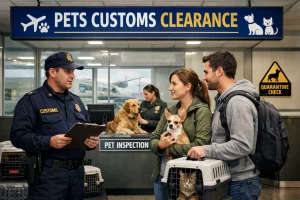
Present documents to the inspection/customs team
Pay applicable fees (if any)
Collect your pet within pickup time windows
Arrange transport home
Airport Drop-Off Checklist (Avoid Last-Minute Issues)
This section saves people. Like seriously.
Required documents at check-in
Carry originals (and 2–3 copies):
Microchip proof
Rabies vaccine certificate
Health certificate (fit-to-fly)
Import/export permits (if required)
Airline forms / shipper declaration
Crate readiness checklist
Correct crate size (pet can stand, turn, lie down)
Ventilation on required sides
Door locks secure
Absorbent bedding (not messy)
Water bowl attached (and filled per airline rule)
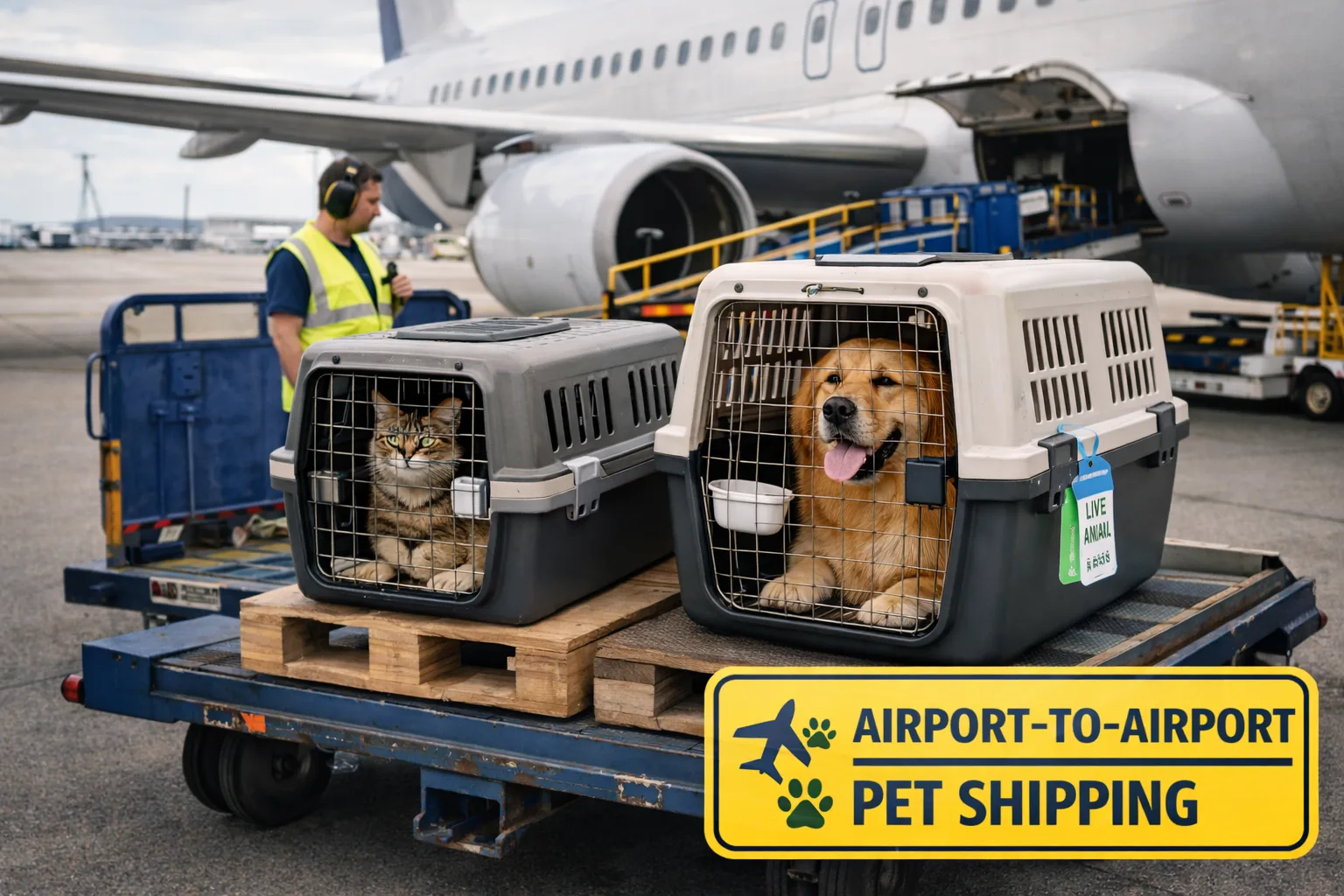
Labels: “LIVE ANIMAL”, arrows, contact details
Feeding and hydration timing
General guidance (always follow your vet advice):
Avoid heavy meals close to departure
Offer water in the hours before travel
Keep it simple—no new foods on travel day
Common reasons pets get rejected at the airport
Crate too small or not airline-approved
Missing labels or weak door locks
Paperwork mismatch (microchip number wrong, dates wrong)
Health certificate outside the allowed time window
Breed/temperature restrictions not met
Late arrival at cargo terminal (this happens a lot)
Documents Required for Airport-to-Airport Pet Shipping
Microchip certificate
Many countries require ISO 11784/11785 microchip. The microchip number must match every document.
Rabies and core vaccination record
Rabies is the big one. Core vaccines depend on destination, but complete records always help.
Fit-to-fly health certificate
Issued by an authorised vet within a destination-specific time window. If it’s outside the window, airlines can refuse.
Import permit / export permit (destination-based)
Not every route needs permits, but many do. We confirm based on your destination.
Rabies titer test (FAVN) for certain countries
Some strict countries require FAVN + waiting periods. This affects your whole timeline, so start early.
Airline forms and shipper declarations
Airlines may require shipper details, feeding instructions, and crate compliance declarations.
Document summary table (typical):
| Document | Needed For | Common Mistake |
|---|---|---|
| Microchip proof | Most countries | Microchip not scanned / number mismatch |
| Rabies certificate | Most countries | Vaccine before microchip (often invalid) |
| Health certificate | Airline + destination | Issued too early / too late |
| Import permit | Some countries | Applying late |
| Export permit | Some origins | Not endorsed/stamped |
| FAVN titer test | Regulated countries | Not allowing waiting period |
IATA Crate Rules for Airport-to-Airport Pet Transport
How to measure your pet for the correct crate size
Measure your pet standing naturally:
Nose to base of tail (length)
Floor to top of head/ears (height)
Shoulder width (width)
A correct crate allows your pet to stand, turn, and lie down comfortably.
Ventilation, locking, labeling, and absorbent bedding
Most airlines want:
Ventilation on multiple sides
Strong locking mechanism (often metal hardware required)
Proper “LIVE ANIMAL” labeling and arrows
Absorbent bedding (no loose straw/hay that spills)
Single vs double crates (when allowed, when not)
Single crate: Standard for most pets
Two pets in one crate: Often not allowed, except very small compatible animals (and airline rules vary). When in doubt, plan separate crates.
Crate mistakes that cause airport rejection
Using a crate that’s “almost” the right size
Wheels still attached
Weak plastic door / broken lock
No water bowl
Poor ventilation
Missing labels and contact details
Cost of Airport-to-Airport Pet Shipping
What impacts cost: size, crate, route, airline, season
Pricing changes based on:
Pet weight + crate dimensions (major factor)
Airline policy and space availability
Direct vs transit route
Destination documentation complexity
Peak season restrictions
Direct flight vs transit flight pricing
Direct flights can cost more but reduce transit risk. Transit routes may cost less, but they increase handling points and time.
Extra charges to expect (handling, customs, storage, inspection)
Common extras at airports:
Handling/terminal fees
Customs inspection fees
Storage charges if pickup is delayed
After-hours pickup fees (some airports)
Cost range table (illustration only):
| Pet Size | Route Type | Typical Range (USD) |
|---|---|---|
| Small cat / small dog | Short/standard route | 900 – 2,200 |
| Medium dog | Standard route | 1,600 – 3,800 |
| Large dog | Long-haul / limited airlines | 2,800 – 6,500 |
| Strict destinations | Tests + permits | 3,500 – 9,500+ |
These are general ranges. Final cost depends on crate size, route, and airline policies.
How Long Does Airport-to-Airport Pet Shipping Take?
Typical timelines by route
Standard routes: 2–6 weeks planning
Permit-heavy routes: 4–10 weeks
FAVN + waiting period destinations: 3–7 months (sometimes more)
What causes delays (permits, titer tests, flight embargoes)
Permit processing delays
Waiting period after rabies/titer test
Airline temperature embargoes
Limited cargo capacity during peak travel
Document errors (most common, and avoidable)
Airline Options and Pet Travel Methods
Cargo vs checked baggage vs cabin (what applies and when)
Cabin: usually only for very small pets on select routes
Checked baggage: some airlines allow pets in hold on the same flight as owner (route-specific)
Cargo (most common for international): dedicated cargo handling, common for larger pets and many international rules
Temperature embargo rules and seasonal restrictions
Airlines may stop pet transport during extreme heat or cold periods. Planning dates and flight times helps a lot.
Breed restrictions (especially snub-nosed breeds)
Many airlines restrict brachycephalic breeds due to breathing risk under stress and heat. We check what is realistically allowed.
Special Cases in Airport-to-Airport Shipping
Brachycephalic (snub-nosed) breeds
Extra care, better timing, and stricter airline checks are normal here.
Large dogs and giant breeds
Large crates need aircraft space. So, early booking matters, otherwise you’ll be stuck changing flights.
Senior pets and nervous travellers
We recommend calm routing, crate training, and vet guidance. Also, sedation is usually not recommended unless a vet specifically advises it.
Multi-pet shipping (same flight vs separate flights)
Sometimes pets can travel on the same flight. Sometimes it’s smarter to split flights (space and handling limits). We guide based on route reality.
Customs & Airport Clearance at Destination
What happens after landing
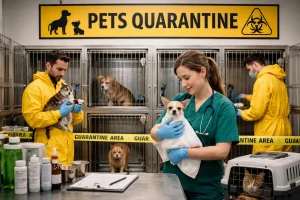
After landing, your pet goes to the designated animal facility/cargo terminal. Then you complete:
Document verification
Inspection (if required)
Fee payment (if applicable)
Release and pickup
Inspections, fees, and document checks
Expect checks for:
Microchip match
Rabies certificate dates
Health certificate validity
Permits and endorsements (if required)
Storage rules and pickup time windows
Airports have pickup time windows. If you delay pickup, storage fees may apply. So yes, plan your arrival schedule properly.
Popular Airport-to-Airport Pet Shipping Routes
(Internally link these to your route pages)
Dubai ↔ London
Example internal link: /routes/dubai-to-london-pet-shipping/
Dubai ↔ Toronto
Example internal link: /routes/dubai-to-toronto-pet-shipping/
Mumbai ↔ Dubai
Example internal link: /routes/mumbai-to-dubai-pet-shipping/
New York ↔ London
Example internal link: /routes/new-york-to-london-pet-shipping/
Dubai ↔ Sydney
Example internal link: /routes/dubai-to-sydney-pet-shipping/