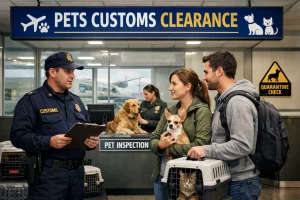
Pets Customs Clearance
Pets Customs Clearance (Dogs & Cats) – Fast, Smooth Release After Landing
When your pet lands in a new country, the journey isn’t “done” yet. The next step is pets customs clearance—and this is where delays can happen if paperwork or timing is wrong.
Our pet customs clearance service helps you avoid stress at the airport. We guide you through document checks, inspection steps, fee payments, and release procedures, so your dog or cat can get out of the terminal and into your arms quickly.
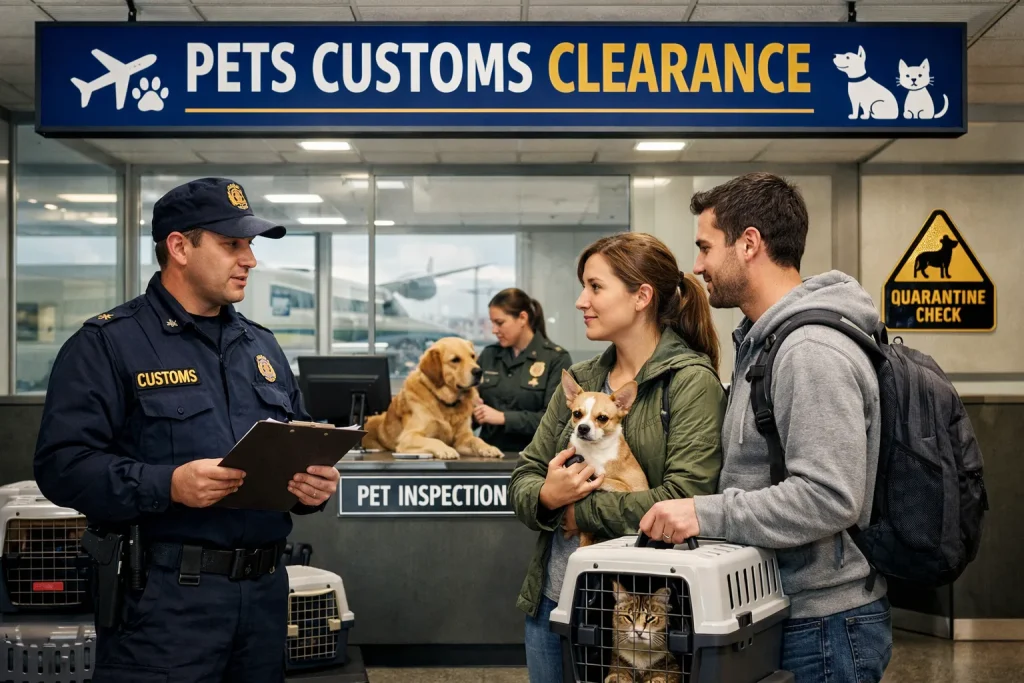
What is pets customs clearance?
It’s the process of getting your pet approved by customs/inspection authorities after landing
Pets customs clearance is the formal process where customs and veterinary/inspection authorities review your pet’s documents and confirm the pet is allowed to enter the country.
Clearance usually includes document checks, health inspection, fee payment, and release
Most clearances include:
Document verification (microchip, vaccines, permits)
Physical inspection (in some cases)
Fees (inspection/handling/storage if applicable)
Release order issued
Pickup scheduling or delivery arrangement
When Do You Need Customs Clearance for Pets?
International arrivals (dog or cat entering a new country)
If your pet enters a new country, customs clearance is required—whether your pet arrives as cargo, checked baggage, or sometimes even in cabin (destination-dependent).
Transit stops and connecting flights (when re-check is required)
Some routes require re-check or terminal transfer processes during transit. If re-check is required, the risk of delay increases, so planning matters.
Returning residents vs first-time imports (rules can differ)
Rules can differ for:
Returning residents bringing pets back
First-time imports
Pets arriving under relocation programs
So, we always check your case type, not just the destination.
Pet Customs Clearance Process (Step-by-Step)
Step 1: Pre-arrival document verification
Before the flight lands, we confirm:
Documents match microchip number
Health certificate is within validity window
Permit approvals are complete (if required)
AWB/booking details are correct
Step 2: On-arrival inspection and document review
At arrival, officials may:
Scan the microchip
Review rabies/vaccine dates
Check permits and endorsements
Conduct a brief health inspection (sometimes)
Step 3: Fee payment (customs/handling/storage if applicable)
Fees can include:
Inspection fees
Terminal/handling fees
Documentation fees
Storage fees (only if pickup is late or clearance is delayed)
Step 4: Release order and pickup scheduling
Once cleared, a release order is issued and the terminal provides the pickup window.
Step 5: Final pickup or delivery to home
After release:
You can pick up your pet (if permitted), or
We arrange delivery (where service is available/required)
Quick flow table:
| Stage | What happens | Your role |
|---|---|---|
| Pre-arrival | Document check + AWB confirmation | Share docs early |
| Arrival | Inspection + document review | Be reachable |
| Fees | Terminal/customs fees | Pay / authorise payment |
| Release | Release order issued | Confirm pickup time |
| Pickup/Delivery | Pet handed over | Pick up or receive delivery |
Documents Required for Pet Import Customs Clearance
Microchip certificate
Microchip proof is the “identity card” for your pet. The number must match all documents exactly.
Rabies vaccination proof + core vaccines
Rabies is the main requirement for most countries. Core vaccines depend on destination but strong records help.
Fit-to-fly / health certificate
A vet-issued health certificate is often time-limited. If it’s expired or issued too early, clearance may stop.
Import permit (if required)
Some destinations require import permits and approvals before arrival.
Rabies titer test (FAVN) for certain destinations
Regulated destinations may require FAVN results and waiting periods. Customs often checks this carefully.
Airline airway bill (AWB) / booking details
If your pet travels as cargo, the AWB (Air Waybill) is a key document used by terminals to locate, process, and release the shipment.
Owner ID / passport + address proof (varies by country)
Many countries request:
Passport/ID copy
Local address or contact details
Sometimes residency proof (depends on destination rules)
Documents checklist table (simple):
| Document | Why it matters | Common issue |
|---|---|---|
| Microchip proof | Confirms pet identity | Chip mismatch / not scannable |
| Rabies certificate | Entry compliance | Wrong timing / booster gaps |
| Health certificate | Fit-to-fly + entry | Expired validity window |
| Import permit | Legal approval | Not issued before arrival |
| FAVN titer test | Regulated countries | Waiting period not met |
| AWB / booking | Terminal processing | Wrong AWB / missing copies |
| Owner ID + address | Legal responsibility | Name mismatch / missing proof |
Common Reasons Pets Get Delayed at Customs
Missing or expired health certificate
If the health certificate is outside the allowed window, clearance may pause until corrected (and that can be tough).
Wrong rabies timing or booster gaps
Late boosters or incorrect waiting periods are a major reason pets get held.
Microchip not scannable or mismatch with documents
If the microchip can’t be scanned or the number doesn’t match, officers may treat it as non-compliant.
Import permit not approved
Arriving without a required permit can lead to hold, re-export risk, or quarantine depending on the country.
Breed restrictions or incomplete declarations
Breed-related restrictions are mostly dog-related and can trigger extra checks.
Arrival outside clearance hours (airport cut-offs)
Some airports and government offices have limited clearance hours. If your pet lands outside those hours, storage may apply.
Customs Fees, Airport Charges & What to Expect
Typical fee types: inspection, handling, documentation, storage
Fees vary by country and airport, but common categories include:
Veterinary inspection fee
Terminal handling fee
Documentation/admin fee
Storage fee (if pickup is late or release is delayed)
When storage fees apply (and how to avoid them)
Storage fees usually apply when:
Clearance is delayed due to paperwork
Pickup happens after the free storage period
Arrival happens outside working hours and pickup is next day
How to avoid it:Share docs early for pre-check
Be ready to pick up quickly after release
Choose arrival timings within clearance hours when possible
Payment methods and who pays (owner vs consignee)
Depending on the route:
The owner pays directly at the terminal
Or the consignee/agent pays on your behalf
We guide you before arrival so you’re not stuck at the counter with confusion.
Sample fee range table (illustration, USD):
| Fee type | Typical range (USD) | Notes |
|---|---|---|
| Inspection / vet check | 30 – 200 | Depends on airport rules |
| Terminal handling | 60 – 350 | More for cargo shipments |
| Documentation/admin | 20 – 150 | Varies by country |
| Storage (per day) | 40 – 250+ | Can increase fast |
| After-hours service | 50 – 300 | Some airports charge extra |
These are general examples only. Real fees depend on airport and local rules.
Airport Pickup vs Door Delivery After Clearance
When you can pick up your pet directly
You can often pick up directly if:
You are available within the pickup window
The airport allows owner pickup
Your documents are complete and fees paid
When delivery is safer or required
Delivery may be safer or required when:
The terminal is far or complicated
You don’t have suitable vehicle/transport
You’re arriving late or with family baggage
Local rules require agent delivery procedures
What happens if a pet arrives unaccompanied (cargo) vs accompanied
Cargo (unaccompanied): Clearance typically happens at the cargo terminal using AWB.
Accompanied (checked baggage / cabin): Clearance may happen via passenger terminal processes (destination-dependent).
Either way, documents still matter.
Clearance for Dogs vs Clearance for Cats (Any Differences?)
Similar core documents, but some countries have extra cat rules
Most countries treat dogs and cats similarly for core documents. However, some destinations may add extra rules for cats (rare, but possible).
Breed restrictions are usually dog-related
Breed restrictions and special controls are mostly for certain dog breeds and mixes.
Parasite treatments (ticks/tapeworm) depend on destination
Parasite treatment rules depend on where you’re going. Some destinations require documented treatments within a specific time window.
Quarantine Rules and Customs Clearance
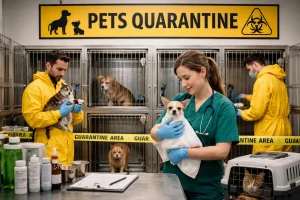
When quarantine is mandatory
Quarantine may be mandatory if:
The destination is a strict quarantine country
Required tests/waiting periods are not met
Documents are incomplete or questionable
Home quarantine vs facility quarantine (destination-based)
Some destinations allow home quarantine, while others require government facility quarantine. Rules depend on destination and compliance level.
How we help coordinate quarantine booking and release
If quarantine applies, we help with:
Booking guidance (where applicable)
Document preparation for admission
Release and post-quarantine steps
Pet Clearance for Transit / Connecting Flights
Direct vs transit routes (what changes at customs)
Direct flights reduce handling points. Transit routes can involve extra terminal processes, and that can increase delay risk.
Re-check and re-documentation risks
Transit can add:
Re-check requirements
Handling transfers
Timing risks if a connection is missed
Tips to reduce delays on transit routes
Choose reliable transit airports known for pet handling
Avoid very short connections
Confirm if re-clearance is required during transit
Keep documents organised and easy to present
How Our Pet Customs Clearance Service Helps
Pre-arrival document review and checklist
We review your document pack before landing, so you catch issues early, not at the counter.
Coordination with airport handling agents
We coordinate with handling partners where possible to speed up processing.
Guidance on inspection steps and release process
We explain what happens at the airport and what you need to do (and what you don’t need to do).
Fee planning and avoiding storage charges
We help you plan likely fees and reduce storage risks by timing and readiness.
Fast pickup/delivery support after clearance
After release, we support fast pickup or arranged delivery, depending on your chosen service.
Countries & Airports We Support
Major airport clearance locations
We support clearance processes at major international hubs (availability depends on route and local rules).
Destination-specific clearance rules (link to destination pages)
Because rules vary, we recommend destination pages for exact entry steps:
/destinations/united-kingdom//destinations/canada//destinations/uae//destinations/australia//destinations/india/
(Internally link to your actual destination hub pages.)
Get Help With Pet Customs Clearance
What we need (arrival airport, flight/AWB, pet details, docs)
To support you quickly, send:
Arrival airport and flight number (or AWB for cargo)
Pet details (dog/cat, breed, age)
Document scans (microchip, rabies, health certificate, permits)
Your contact number and pickup preference
Request quick assistance (form/WhatsApp/email/phone)
Form: Best for full details and document upload
WhatsApp: Fast support for urgent arrivals
Email: Good for sending PDFs and scans
Phone: Useful if clearance time is tight.