Relocating a dog from New Zealand to Singapore is very doable, however Singapore’s entry process is strict and timeline-driven. If you plan it in the right order, the trip can feel surprisingly smooth: the crate is compliant, the flight routing is sensible, and the arrival clearance at Changi is quick.
This guide breaks it down into three big pieces: IATA crate rules, airline routing, and Singapore arrival steps—with the key permits and vet documents in the middle.
1) New Zealand to Singapore import category (what it means for quarantine)
Singapore’s Animal & Veterinary Service (AVS/NParks) groups countries into schedules based on rabies risk. New Zealand is listed under Schedule I.
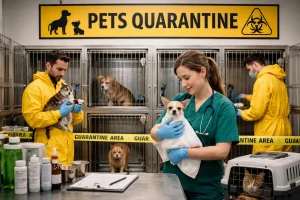
The good news: for Schedule I countries (including New Zealand), the veterinary conditions document states no quarantine applies if all requirements are met and your dog is clinically healthy on arrival.
That said, don’t treat “no quarantine” like “no paperwork.” In Singapore, the paperwork is the gate.
2) The core Singapore AVS requirements for dogs from New Zealand
For a smooth dog relocation New Zealand to Singapore, these are the big compliance points that commonly trip people up:
Your dog must be old enough
Singapore requires your dog/cat to be at least 12 weeks old at the time of export.
Microchip: ISO standard matters
Your dog needs to be microchipped to the ISO 11784/11785 standard (or you need to carry a compatible reader).
Vaccinations (dogs)
For Schedule I, the veterinary conditions specify vaccination against:
- Canine distemper
- Canine adenovirus type 1
- Canine parvovirus type 2
The timing of the vaccinations depends on the age (less than 16 weeks vs. 16+ weeks) but clearly they want to see them done as per manufacturers instructions and within the necessary time before exporting.
Parasite treatments (close to departure)
Schedule I conditions require treatment:
- against external parasites (fleas/ticks) and
- against internal parasites (nematodes/cestodes)
between 2 and 7 days of export (active ingredient and date must be stated).
The health certificate window is tight
The veterinary certificate must be dated not more than 7 days prior to export, signed by a government approved vet and endorsed by an official government veterinarian (per the Schedule I conditions).
Breed restrictions (yes, Singapore has them)
Singapore restricts import of certain dog breeds (and crosses). Schedule I conditions list breeds not allowed (including Pit Bull–type dogs and others).
3) IATA crate rules (and what airlines actually check)
When people search “IATA crate requirements Singapore”, they’re usually worried about two things: size and build quality.
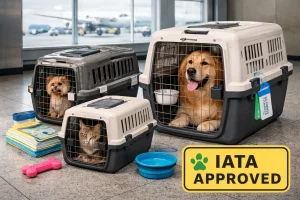
The non-negotiables: IATA compliant, escape-proof, ventilated
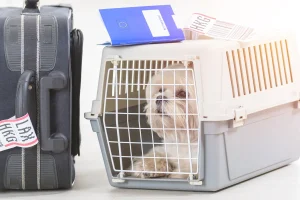
Singapore’s Schedule I conditions explicitly require dogs to be transported in escape-proof containers conforming to the latest IATA Live Animals Regulations (LAR).
Air New Zealand Cargo also notes it uses IATA LAR as a minimum standard, and that crates must be IATA compliant.
One dog per crate (usually)
IATA guidance for Pet notes that animals over 14 kg must be crated individually, and only certain small compatible animals may share (which generally isn’t relevant for adult dogs).
What to place inside the crate (and what not to)
Air New Zealand Cargo recommends a blanket with a familiar scent, and also lists items they prohibit in pet crates (including sharp/metal objects, pet food, bean bags and toys).
Practical tip: put a thin, vet-approved absorbent layer and a familiar-smelling towel/blanket (nothing bulky). Also, label the crate clearly with microchip number and contact info—small thing, big stress saver.
4) Airline routing from New Zealand to Singapore (how to choose the safest path)
Routing is where “easy” can turn into “messy,” so keep it simple.
Aim for fewer flight legs and minimal handling
Every extra stop adds:
- more handling time on the tarmac,
- more temperature changes,
- more chances for paperwork confusion.
Schedule I conditions also talk about transit/landing controls: the captain’s declaration relates to where the dog was embarked and whether it was landed at intermediate ports, and notes that if an aircraft change is required, prior permission from NParks/AVS is required.
So, if you’re forced into a multi-leg route, treat it as a higher-risk plan and confirm the compliance steps early.
Cargo vs accompanied baggage
In real life, many international pet moves run as manifested cargo (handled through cargo facilities), even when the owner travels separately. The arrival process differs depending on whether your pet is manifested cargo or accompanied/excess baggage—Singapore AVS explains both clearance procedures.
Air New Zealand cargo timing expectations
Air New Zealand Cargo notes pets typically must be presented at least 3 hours pre-flight (sometimes 4 hours depending on security and local conditions).
Related Articles:
» How do I prepare my pet for international relocation?
» Moving a cat from Netherlands to USA: stress reduction + paperwork checklist
» Netherlands to USA Pet Relocation Step-by-Step Guide (Dogs & Cats)
» Moving a Cat from USA to Kuwait: Stress Reduction + Paperwork Checklist
» Pet Shipping from UAE to Spain: Documents, Timeline, and Cost Factors
5) Step-by-step timeline (NZ → Singapore dog move)
Here’s a clean planning flow that matches the official timing windows.
|
When |
What to do |
Why it matters |
|
4–8 weeks out |
Confirm your dog is eligible (age, breed). Start crate training. |
Avoid last-minute surprises with restricted breeds; crate training reduces stress. |
|
3–6 weeks out |
Check Singapore AVS country schedule and requirements again close to travel date. |
AVS notes categorisation can change. |
|
2–3 weeks out |
Arrange paperwork workflow: dog licence + import licence (Singapore side). |
Schedule I requires valid NParks/AVS import licence and dog licence. |
|
≥5 days before arrival |
Book the CAPQ inspection appointment in Singapore. |
Request must be submitted at least 5 days before arrival; walk-ins can trigger hourly inspection fee. |
|
7 days before export |
Vet exam + official health certificate within the allowed date window. |
Certificate must be dated not more than 7 days prior to export. |
|
2–7 days before export |
Flea/tick + worm treatments with active ingredients recorded. |
Required timing window for treatments. |
|
Flight day |
Arrive early for cargo acceptance + keep documents in one folder. |
Air NZ Cargo notes 3+ hours pre-flight is common. |
6) Singapore arrival steps at Changi (CAPQ clearance, simple but strict)
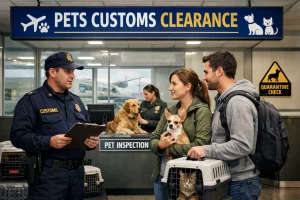
Singapore AVS requires imported pets to be inspected at the Changi Animal & Plant Quarantine Station (CAPQ) upon arrival.
Before your pet arrives
- Obtain the correct Customs In-Payment (GST) permit (or approved GST relief if eligible).
- Ensure your CAPQ inspection appointment is booked at least 5 days prior.
If your dog arrives as manifested cargo (common for international moves)
Singapore’s arrival clearance doc outlines this flow:
- Get a Visitor Pass at the Police Pass Office (cargo complex entry).
- Go to the airline cargo office (SATS/dnata) and collect documents.
- Proceed to CAPQ with originals: import licence, health certificate, vaccination records, rabies serology result (if applicable), airway bill, captain’s declaration (where applicable).
At CAPQ, the officer verifies documents, checks microchip, and does a visual health inspection.
Late arrivals warning: AVS encourages selecting flights that arrive at least 3 hours before CAPQ closing time, otherwise pets may be held overnight at the ground handler’s holding room.
7) Documents checklist (print + keep duplicates)
For pet shipping New Zealand to Singapore, build a folder like this:
- NParks/AVS import licence + Singapore dog licence
- Government-endorsed veterinary health certificate (within 7 days of export)
- Vaccination record with microchip number
- Parasite treatment record (2–7 days prior)
- CAPQ inspection appointment confirmation
- Airway bill / flight paperwork (if cargo)
- Customs GST permit / GST relief approval (if applicable)
8) A few “don’t mess this up” tips (from real-world moves)
- Crate training beats calming tricks. Start early, go slow, make the crate boring and safe.
- Choose the simplest route you can afford. Less handling = less stress.
- Don’t wing it with document timing. The 7-day certificate window and 2–7 day parasite window are tight, so book the vet early.
- Arrive earlier than you think at cargo acceptance—especially with a nervous dog.
Also: write your dog’s feeding instructions clearly. Even if you’re not allowed to place food inside the crate (Air NZ lists restrictions), your handler still needs clarity.
FAQs: New Zealand to Singapore dog relocation
Usually no—Schedule I states no quarantine if all veterinary regulations are met and your dog is clinically healthy.
It’s the Changi Animal & Plant Quarantine Station, where all imported pets must be inspected on arrival.
At least 5 days before arrival.
AVS warns you may be charged an inspection fee (hourly) when you arrive without a prior appointment.
ISO 11784 / ISO 11785 Annex A compliant microchips (or provide a compatible reader).
Vaccination of distemper, adenovirus type 1 and parvovirus type 2 is mandatory according to Schedule I with age-based timing.
2-7 days before export with active ingredients and date recorded.
Dated not more than 7 days prior to export (and signed/endorsed as required).
Yes—Singapore requires an escape-proof container conforming to IATA LAR, and airlines like Air NZ reference IATA LAR as the minimum standard.
IATA guidance says animals over 14 kg must be crated individually; sharing is limited to specific cases (typically small, compatible animals).
You’ll typically deal with SATS/dnata paperwork and then proceed to CAPQ for inspection/clearance.
Pets are subject to GST unless relief applies; Singapore Customs explains GST is based on CIF value and outlines possible relief and permit steps.