Moving with a dog or cat is already emotional. Add an international flight from Sweden to Oman, and suddenly you’re juggling paperwork, vaccination dates, and crate rules—while your Pet just wants dinner on time. The good news?Plan ahead and stick to Oman’s import procedures, though, and the process is fairly routine.
Here is how a simple pet transport from Sweden to Oman should go, what documents you’d need, when suitable time frame would be and the main price influencers which usually increase the cost.
1) Sweden to Oman pet import rules (the big picture)
For dogs and cats, Oman requires a prior veterinary import permit, plus proof of ID and rabies compliance. Oman’s customs guidance also lists age minimums, rabies timing, a rabies antibody blood test requirement (FAVN/RNATT), and a banned-breed list for dogs.
On the Sweden side, the Swedish Board of Agriculture (Jordbruksverket) advises you to confirm the destination country’s requirements in writing and to use an official veterinarian to issue certificates.
So your plan should be simple: build your schedule around Oman’s rabies + titer timing, and line up Sweden’s certificate appointment at the end.
2) Required documents for pet shipping from Sweden to Oman
Here’s the checklist most shippers use for dogs and cats:
A) Oman-side documents (import side)
According to Oman Customs, you’ll typically need:
- Veterinary import permit (approved before arrival)
- Government veterinary health certificate from Sweden
- Passport / immunization record (vaccinations from birth onward)
- Rabies antibody titration certificate from an accredited lab (FAVN/RNATT)
Permit fee: Oman Customs lists an application fee of OMR 20.
B) Pet identification + medical proof (the “must-have” folder)
- Microchip number recorded in the immunization record (Oman Customs expects the microchip to appear on the record).
- Rabies
vaccination proof (with correct timing—see timeline below) - General vaccine record (many airlines also like to see routine vaccines up to date)
C) Sweden-side paperwork (export side)
Sweden’s Board of Agriculture notes that certificates must be issued by official veterinarians, and you should confirm whether Oman accepts Sweden’s export certificate format.
Practical takeaway: book your official vet appointment early, but schedule the final certificate close to travel once your timeline locks.
3) Rabies rules + the titer test (FAVN/RNATT) — the part that controls everything
Oman Customs spells out the rabies steps clearly:
- Your pet must receive rabies vaccination after 12 weeks of age.
- The rabies shot must be no more than 12 months old at import.
- You must take a blood sample for FAVN/RNATT 21–30 days after the last rabies vaccination.
- From the date the lab issues the titer result, Oman expects a waiting period of at least 3 months, and the result must be not more than 12 months old at export/import.
That means you can’t “rush” this in two weeks. If anyone promises that, be careful.
4) Sweden to Oman timeline (realistic planning schedule)
Below is a clean timeline you can follow. I’m assuming air travel and a normal family pet (not commercial breeding/sale).
Timeline table (typical)
|
Time before departure |
What you do |
Why it matters |
|
12–16+ weeks |
Choose route (direct vs transit), decide accompanied baggage vs manifest cargo, shortlist airlines/agent |
Airline rules can change; cargo space can fill fast |
|
10–12 weeks |
Confirm Oman requirements + start your import permit prep |
Oman requires a prior permit |
|
8–10 weeks |
Microchip check + rabies vaccination review |
Oman expects microchip listed in records |
|
6–9 weeks |
Rabies vaccination (if needed/renewal) then wait |
Rabies timing controls blood test window |
|
5–8 weeks |
Do FAVN/RNATT blood draw 21–30 days after rabies |
This timing is specifically required |
|
3+ months after titer result date |
Earliest safe import window |
Oman requires ≥ 3 months since result issuance |
|
7–10 days |
Book final official vet exam and health certificate |
Sweden: only official vets issue certificates |
|
48–72 hours |
Crate check, label set, feeding/water plan, airport arrival plan |
Avoid last-minute refusals at check-in |
Important age rule: Oman Customs states pets must be more than four months old.
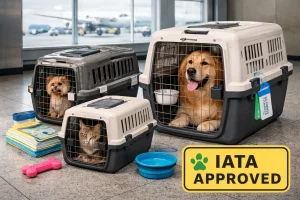
5) Airline and crate rules (IATA matters more than people think)
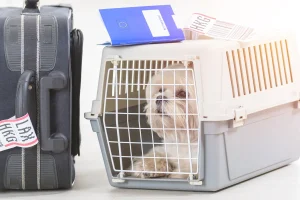
Even if your papers are perfect, the airline can refuse travel if the crate fails inspection.
IATA guidance emphasizes compliant containers, correct ventilation/labels, and safety standards; staff can reject a crate that doesn’t meet minimum standards.
A few crate basics from IATA container requirements include:
- Proper ventilation and safe openings
- Secure construction (rigid plastic/metal/wood standards; avoid unsuitable wire-only crates)
- Pet must be able to stand, sit upright, turn, and lie naturally
If you’re unsure, buy an IATA-compliant crate and do a “practice stay” at home for a week. It reduces stress and prevents travel-day drama.
6) Banned breeds and restrictions (don’t skip this)
Oman Customs lists prohibited dog types under a referenced resolution and includes breeds such as Pitbull, Rottweiler, Doberman Pinscher, Boxer, Great Dane, and others, including mixes of the listed breeds.
If your dog looks similar to a restricted type, don’t rely on “it will be fine.” Confirm in writing before you spend money on the process.
Related Articles:
» Moving a Cat from USA to Kuwait: Stress Reduction + Paperwork Checklist
» Netherlands to USA Pet Relocation Step-by-Step Guide (Dogs & Cats)
» Moving a cat from Netherlands to USA: stress reduction + paperwork checklist
» Pet Shipping from UAE to Spain: Documents, Timeline, and Cost Factors
» Moving a Dog from the Netherlands to Norway: Crate Rules, Airline Routing, and Arrival Steps
7) Cost factors: what makes Sweden to Oman pet shipping expensive (or reasonable)
Every quote you receive should break costs into components. That way you can spot hidden fees.
Cost breakdown table (what usually affects pricing)
|
Cost component |
What changes the price |
Notes |
|
Import permit (Oman) |
Fixed fee |
Oman Customs lists OMR 20 |
|
Vet visits + certification |
Number of appointments + official vet charges |
Sweden export certificates require official vets |
|
Rabies titer test (FAVN/RNATT) |
Lab fees + courier + repeat testing risk |
Oman requires accredited lab proof |
|
Flight cost (airline) |
Route, season, cargo vs cabin, transit vs direct |
Transit can add handling costs |
|
Crate |
Size + quality |
Must meet IATA expectations |
|
Handling & clearance |
Airport handling, inspection time, agent fees |
Oman notes fast permit processing during work hours |
|
“Surprises” |
Wrong dates, missing microchip number, crate rejection |
Most extra costs come from last-minute rework |
The biggest cost driver (in plain words)
Your pet’s size + crate size usually drives the airline price because cargo often uses dimensional weight. Bigger crate = bigger charge. So a calm, well-trained pet that fits a correct-sized crate (not oversized) can literally cost less to ship.
8) Tips to reduce stress and avoid delays
- Keep one folder with microchip proof + rabies + titer + permit + health certificate (printed + scanned). Oman Customs expects these documents at arrival.
- Don’t guess dates. Use a calendar and lock in: rabies → 21–30 days → blood draw → wait 3 months after result issuance.
- Crate-train early. A crate shouldn’t feel like punishment on flight day.
- Avoid heavy meals right before travel (your vet can advise what’s safe for your pet).
Choose routes with fewer transfers when possible—fewer handoffs usually means fewer risks.
FAQs: Pet shipping from Sweden to Oman
You generally need an Oman import permit, a Sweden government vet health certificate, an immunization record, and a rabies titer (FAVN/RNATT) certificate from an accredited lab.
In many cases, plan for 3–4+ months, mainly due to the titer-test timing and Oman’s waiting period.
Oman Customs states dogs and cats must be more than four months old.
Oman Customs notes rabies vaccination must happen after 12 weeks of age, and the vaccine must be within the allowed validity window at import.
Oman Customs specifies 21–30 days after the last rabies immunization.
Yes—Oman Customs indicates the period from the result date should be not less than three months (and within the maximum validity they state).
It’s a crate that meets airline/IATA Live Animals Regulations standards regarding safety, ventilation, labeling and sizing — airlines can turn down crates that don’t meet these standards.
It depends on airline policy, pet weight, and routing. Many international routes use cargo/manifest for pets—always confirmed with the airline.
Oman Customs lists prohibited breeds/types and includes several well-known breeds and “mixed breeds of the above mentioned breeds.”