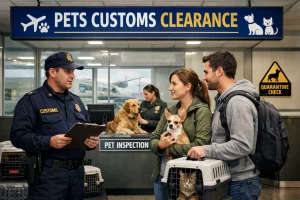
The prospect of moving your dog from France to South Korea seems quite terrifying on day one and completely manageable when you view it as a project: paperwork first, crate training, flights and arrival at the airport for quarantine .
In reality, there are two main reasons for delays: (1) an antibody (titer) test that is run too late, and the checking of a crate that does not meet IATA airline standards. So, early on let’s get those straightened out and everything else will follow.
1) South Korea dog import requirements (what officials check first)
South Korea’s entry checks focus on identity + rabies control. As a baseline, plan for:
- Microchip (ISO-compliant) in place before you finalise the health paperwork.
- Rabies vaccination that remains valid on the day your dog lands.
- Rabies-neutralisation antibody test (titer) showing ≥ 0.5 IU/ml (commonly via FAVN/RFFIT) for dogs 90 days or older.
- Official health certificate / quarantine certificate issued and endorsed by the exporting country’s competent authority (in France, you’ll coordinate via your vet + local official process).
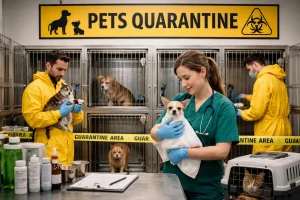
If you miss the microchip and/or the titer requirement, Korea can hold your dog in quarantine at your cost until you complete what’s missing.
Important: rules can shift and airlines also add their own rules, so treat this guide as the workflow, then verify your exact paperwork with your vet and carrier.
2) Timeline planner (France → South Korea) you can actually follow
Here’s a realistic planning table that keeps you out of last-minute panic.
|
When to do it |
What you do |
Why it matters |
|
8–12 weeks before flying |
Confirm your dog’s microchip, update rabies vaccine if needed |
Korea checks identity + rabies status |
|
6–10 weeks before |
Do the rabies titer test (≥ 0.5 IU/ml) and store the lab report safely |
This is the #1 schedule breaker if delayed |
|
4–8 weeks before |
Start crate training daily + pick a routing that fits your dog |
Stress drops a lot when the crate feels “normal” |
|
2–4 weeks before |
Book flight space (pet quota is real), decide cabin vs hold vs cargo |
Many flights cap pets per aircraft |
|
Final 7–10 days |
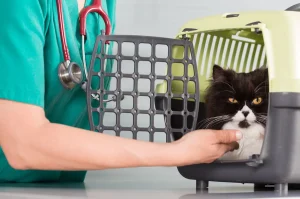
Vet exam + health certificate steps (per airline + official requirements) |
Certificates are time-sensitive |
|
Travel day |
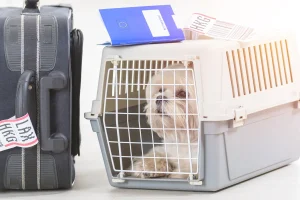
Early check-in, documents in hand, water plan |
Smooth check-in prevents missed flights |
|
Arrival day |
Declare at airport, quarantine inspection, release |
Don’t skip the declaration step |
3) IATA crate rules (and how to choose the right crate size)
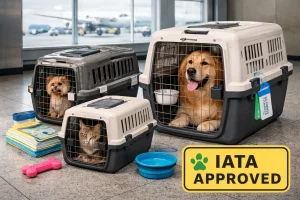
For safety and the well-being of the animals, airlines adhere to IATA Live Animals Regulations (LAR). In practical terms, your dog’s crate should be durable and safe, while providing ample ventilation.
The crate sizing formula airlines recognise
IATA provides a practical measurement method (internal crate dimensions):
- Length = A + ½B
- Width = C × 2
- Height = D + bedding
- Snub-nosed breeds often need ~10% larger crate space.
Where:
- A = nose to base of tail
- B = ground to elbow
- C = shoulder width (widest point)
- D = standing height to ear tip/head top
Quick crate checklist (the “airline won’t reject it” list)
Aim for:
- Hard-sided crate (most airlines prefer rigid plastic or similar)
- Ventilation on multiple sides (IATA highlights ventilation as critical)
- Secure, metal door and strong fasteners (no flimsy clips)
- Absorbent bedding, no loose items that can choke
- Two empty dishes fixed inside (water + food) — many airlines insist on fixed bowls
Tip that saves real money: buy the crate early. Then train with it daily, because a calm dog makes check-in easier, and it reduces “crate damage” risk too.
4) Airline routing from France to South Korea (what usually works best)
For France → South Korea pet transport, you’ll usually choose one of three methods:
Option A: In-cabin (small dogs only)
- Best for tiny dogs that fit airline size/weight limits (each airline differs)
- Less temperature risk, more comfort
- However, availability is tight and some routes don’t allow it
Option B: Checked baggage in the hold (owner on same flight)
- Works for many medium dogs depending on airline policy
- Often cheaper than cargo
- Still subject to seasonal heat/cold limits and breed restrictions
Option C: Manifest cargo (unaccompanied or required by airline)
- Common for larger dogs or certain airlines/routes
- Requires earlier documentation cut-offs and cargo terminal procedures
- Often the most controlled handling, but it can cost more
Routing strategy that reduces stress
Whenever you can, choose:
- Direct flight (least handling, least risk of missed connections), or
- One-stop routing with a big, pet-experienced hub and a decent connection window.
Avoid “two short connections” because a minor delay can snowball. Also, avoid tight transfers; your dog is not a backpack, and ground teams need time.
Related Articles:
» Moving a cat from Netherlands to USA: stress reduction + paperwork checklist
» Netherlands to USA Pet Relocation Step-by-Step Guide (Dogs & Cats)
» Moving a Dog from the Netherlands to Norway: Crate Rules, Airline Routing, and Arrival Steps
» Pet Shipping from UAE to Spain: Documents, Timeline, and Cost Factors
5) The documents checklist (print this and tick it off)
Most successful moves rely on a clean, consistent document pack:
|
Document |
Must show |
Keep copies? |
|
Microchip record |
Chip number matches ALL papers |
Yes (2–3 copies) |
|
Rabies certificate |
Vaccine date + validity |
Yes |
|
Rabies titer lab report |
Result ≥ 0.5 IU/ml + dog identity |
Yes |
|
Official health / quarantine certificate |
Issued and endorsed as required |
Yes + scanned PDF |
|
Flight booking confirmation |
Pet booking reference / cargo AWB if cargo |
Yes |
|
Crate compliance notes |
Internal dimensions + build |
Helpful at check-in |
South Korea expects you to present a quarantine certificate from the exporting country and declare the animal for quarantine inspection on arrival.
On the France side, official guidance stresses that requirements vary by destination and advises contacting the relevant authorities (often via your local DDPP process) and checking airline transport conditions in advance.
6) Arrival steps in South Korea (Incheon and other airports)
After landing, don’t rush out like it’s a normal holiday. Do this instead:
- Declare your dog on the Customs declaration form and follow the “goods to declare” guidance to the quarantine area.
- Present your quarantine/health certificate and supporting vaccination/titer paperwork.
- The quarantine officer checks identity and documents, and they may perform a brief health inspection.
- If everything matches, you typically get release the same day.
- If something is missing (often microchip/titer), authorities may keep your dog under quarantine until completion, and you pay the costs.
Pro move: keep your documents in a clear folder in this order: microchip → rabies vaccine → titer result → health certificate → flight papers. You will look organised, and it speeds up the counter chat a lot.
7) Cost factors (what usually changes the final price)
Pricing varies wildly, but the cost is driven by:
- Dog size/weight + crate size (bigger crate = bigger freight charge)
- Cabin vs hold vs cargo method
- Route complexity (direct vs connection)
- Vet work + lab tests + certificate endorsements
- Optional services: door pickup, boarding, customs broker support, arrival delivery
|
Cost area |
Typical range (ballpark) |
|
Crate + setup |
€80–€400+ (size dependent) |
|
Vet consult + vaccines |
€50–€200+ |
|
Rabies titer test |
€80–€200+ (lab dependent) |
|
Flight pet fee / cargo fee |
Varies the most (often hundreds to thousands) |
|
Handling/terminal fees |
Airport/airline dependent |
If you want a predictable price, the Pet shipper would be happy to quote for this carriage based on crate dimensions, dog weight, breed and destination airport . Absent that, any quote is just speculation.
8) Practical tips that prevent common mistakes
- It’s also possible that your dog may not be sedated unless specifically recommended by your veterinarian; many airlines discourage regular sedation for in-flight risk.
- Place a piece of used T-shirt (your scent) outside the crate (airline rules permitting), not loose inside.
- Freeze some water in a bowl the night before so it melts little by little along the way.
Attach a zip pouch with copies of documents on the crate (again, airline rules vary).
FAQs: France → South Korea dog travel
Usually yes for dogs 90 days+, and the result must be ≥ 0.5 IU/ml.
Yes, Korea requires an ISO-compliant microchip for entry checks.
Plan 6–12 weeks to do vaccinations, titer timing, crate training, and flight booking safely.
If paperwork matches, release can happen the same day after inspection; if you lack microchip/titer, quarantine may occur at your expense.
The majority of international arrivals pass through Incheon (ICN), where there are straightforward quarantine procedures, and other airports also conduct quarantine inspection.
Only if your dog meets the airline’s size/weight limits and route rules. Many medium/large dogs must fly in the hold or as cargo.
IATA uses formulas like Length = A + ½B, Width = C×2, Height = D + bedding.
A non-compliant crate or documents that don’t match (microchip number mismatch is a classic).
Yes. Still, choose one good connection rather than two risky ones, and avoid tight layovers.
Yes—travelers must declare animals and undergo quarantine inspection procedures.
It depends on crate size, method (cabin/hold/cargo), and route. Large dogs moving as cargo can cost significantly more.
If your routing is simple and your dog is small, DIY can work. However, for cargo moves, tight timelines, or anxious pets, a pet shipping service often saves you from paperwork mistakes.