Pet Travel Documents
Pet Travel Documents for International Flights (Dogs & Cats)
Planning to fly with your dog or cat internationally? Then paperwork is not optional. In fact, pet travel documents decide whether your pet boards the flight, clears customs, or gets delayed (or worse, quarantined).
The good news: once you follow a clear checklist and timeline, it becomes manageable. We help you understand exactly what you need for your route, and we review documents before travel so you don’t get last-minute surprises at the airport.
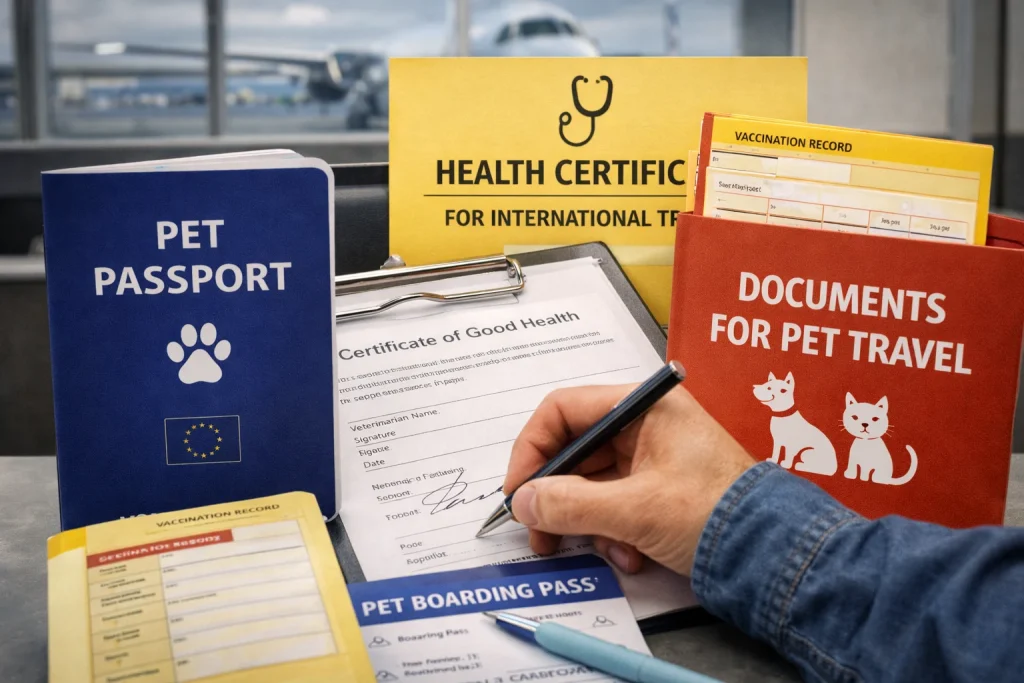
What are pet travel documents for international flights?
Pet travel documents are the official papers that prove your pet’s identity, vaccination status, health condition, and legal permission to enter another country.
They’re the official papers that prove identity, vaccinations, and import permission
Most countries want proof of:
Microchip identity (often ISO standard)
Rabies vaccination and sometimes other vaccines
A Fit-to-Fly health certificate
Import permit / approvals (for some destinations)
Additional tests (like rabies titer test / FAVN) for regulated countries
Without correct paperwork, pets can be delayed, rejected, or quarantined
If paperwork is missing or incorrect, airlines can refuse boarding, and customs can hold your pet. This can lead to:
Flight rejection at check-in
Long storage waiting at the airport
Extra fees and rebooking
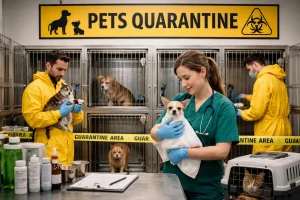
Quarantine in strict destinations
It’s stressful and expensive, so it’s better to do it correctly the first time.
Documents Needed to Fly a Dog or Cat Internationally
Core documents required for most countries
Most international routes require:
Microchip certificate
Rabies vaccination certificate
Health certificate / Fit-to-Fly certificate
Owner/shipper identification details
Airline forms (depending on travel method)
Documents that change by destination (permit, titer test, quarantine papers)
Some countries add extra requirements such as:
Import permit
Export permit
Rabies titer test (FAVN) + waiting period
Parasite treatment proof
Quarantine booking/approval paperwork
Airline documents vs government documents (what’s the difference?)
Government documents are for customs and veterinary authorities (permits, health certificates, titer test results).
Airline documents are for transport and safety compliance (shipper declaration, booking paperwork, crate compliance notes).
You usually need both, and they must match each other (same microchip number, same pet details).
Pet Travel Documents Checklist (Most Countries)
Microchip certificate (ISO standard where required)
Many countries require an ISO 11784/11785 microchip. Even when not mandatory, microchipping is strongly recommended.
Rabies vaccination certificate + core vaccines
Rabies is the main requirement. Core vaccines can vary, but clean vaccination records always help.
Health certificate / Fit-to-Fly certificate
A licensed vet issues a health certificate within a strict time window before departure (and sometimes before arrival too).
Import permit and/or export permit (destination-based)
Not every destination requires permits, but many do—especially regulated routes and Gulf region entries.
Parasite treatment proof (when required)
Some destinations require tick/tapeworm treatments within a specific time window. Timing matters a lot here.
Airline forms + shipper declarations
Airlines may require shipper details, emergency contacts, feeding instructions, and crate compliance information.
Quick checklist table (typical routes):
| Document | Who provides it | Needed for | Common mistake |
|---|---|---|---|
| Microchip certificate | Vet / registry | Identity verification | Chip number mismatch |
| Rabies certificate | Vet | Entry + airline rules | Rabies done before microchip (often invalid) |
| Fit-to-Fly / Health certificate | Vet (approved) | Boarding + customs | Issued outside validity window |
| Import permit | Destination authority | Entry approval | Applying too late |
| Export permit | Origin authority | Exit approval | Missing endorsement/stamp |
| FAVN titer test | Approved lab | Regulated countries | Not planning waiting period |
| Parasite treatment proof | Vet | Some countries | Treatment done outside allowed window |
| Airline forms | Airline/cargo agent | Transport compliance | Missing signatures / wrong details |
Health Certificate for Pet Travel (Fit-to-Fly)
What the vet must include in the certificate
A strong health certificate typically includes:
Pet details (name, breed, colour, DOB/age)
Microchip number and scan confirmation
Vaccination status (especially rabies)
Vet confirmation the pet is healthy and fit to travel
Vet stamp, signature, clinic details, and date
Destination details (in many cases)
Validity window (why timing matters)
Fit-to-fly certificates are time-sensitive. Many are valid for only a few days (or sometimes up to 10 days), depending on the destination and airline. If your certificate expires before arrival, customs can reject it.
Common mistakes that cause rejection
Wrong microchip number (even one digit off)
Certificate issued too early
Missing vet stamp/signature
Pet details written differently across documents (name spelling, breed, DOB)
Using a non-authorised vet when destination needs government endorsement
Import Permit & Export Permit Assistance
When a permit is mandatory
Permits are often required when:
The destination has strict entry rules
The destination is in a regulated region (some Gulf routes)
Your pet type/breed needs special approval
There are quarantine requirements
How long permits take and how to plan timelines
Permit times vary widely. Some are fast, while others take weeks. So, the safest approach is:
Start early
Apply only after confirming microchip + rabies timing
Keep buffer time before your flight date
Supporting documents usually required
Permits commonly ask for:
Microchip proof
Rabies certificate
Owner passport copy (or ID)
Pet photo sometimes
Health certificate (in some cases)
Address details at destination
Rabies Titer Test (FAVN) – When You Need It
What a titer test proves
A rabies titer test (FAVN) checks if your pet has enough rabies antibodies after vaccination. It’s often required for countries that want extra rabies control assurance.
Waiting periods and timelines
This is the big catch: many destinations require a waiting period after the blood sample date (or after result date). That means you cannot plan this in a hurry.
Tips to avoid test delays
Use an approved lab (country-specific approved list)
Confirm the blood draw is done after correct rabies vaccination timing
Keep copies of lab submission forms and tracking
Don’t book flights until you understand the waiting period
Microchip and Vaccination Requirements
Microchip standards and scanning
Even if your pet has a chip, it must be scannable and recorded correctly. Some countries require ISO chips, so confirm early.
Rabies rules (age limits, booster timing, expiry)
Most destinations have rules around:
Minimum age for rabies vaccination
Waiting time after first rabies vaccine
Booster validity and “no-lapse” rules
If the booster is late (even by days), some countries treat it like a first vaccine again.
Vaccine record format (what customs officers look for)
Customs officers typically look for:
Clear dates (day/month/year)
Vaccine manufacturer and batch/lot number (sometimes)
Vet stamp and signature
Microchip number linked to the record
Country-Specific Rules (Documents Change by Destination)
Strict destinations (example: Australia / New Zealand style rules)
Strict destinations may require:
Government approvals
Approved quarantine arrangements
Titer test and long planning timelines
If you are going to a strict destination, start planning months ahead.
EU-style travel rules (pet passport vs certificates)
In some regions, pets may travel using a pet passport system. In others, you will use certificates and endorsements. The rule depends on your origin + destination combination, not just “Europe” in general.
Gulf region requirements (permits and approvals)
Many Gulf routes involve:
Import permits or approvals
Specific vaccination requirements
Airline compliance check
Airline Documentation & Check-In Requirements
Cargo vs cabin vs checked baggage paperwork
Cabin travel: small pets, extra airline forms, carrier requirements
Checked baggage: route-dependent, airline-dependent paperwork
Cargo: shipper declaration, terminal handling forms, booking documents, and crate compliance notes
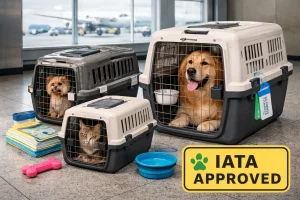
IATA crate labels and required markings
Most airlines require:
“LIVE ANIMAL” label
Up arrows on the crate
Shipper and consignee contact info
Feeding/water instructions (sometimes)
Common airline form requirements
Airlines may ask for:
Shipper declaration
Emergency contact numbers
Pet details matching the booking exactly
Health certificate copies (and originals shown at check-in)
Timeline Planner – When to Start Pet Travel Documents
1–2 weeks cases (simple routes)
Possible when:
No permits required
No titer test required
Airline space is available
Your pet already has microchip + current rabies vaccine
4–12+ weeks cases (titer test + permit destinations)
Needed when:
Import permits take time
Titer test and waiting period apply
Government endorsement is required
Quarantine bookings must be arranged
The safest way to plan around flight dates
Best practice:
Decide destination rules first
Build the document timeline backwards from flight date
Add buffer time for approvals, lab results, and booking changes
Timeline table (planning guide):
| Route type | Suggested planning time | Why |
|---|---|---|
| Simple routes | 1–2 weeks | Health certificate + basic docs |
| Standard international | 2–6 weeks | Vet schedule + airline booking |
| Permit destinations | 4–10 weeks | Permit processing + approvals |
| Titer test destinations | 3–7 months | Lab + waiting period |
How We Help With Pet Travel Documents
Step-by-step checklist for your route
We create a checklist based on your origin and destination, not a generic template.
Document review to prevent rejections
We review:
Microchip number consistency
Vaccine date logic
Certificate validity windows
Permit/endorsement completeness
This reduces the chance of airport rejection.
Coordination with vet clinics (where possible)
Where possible, we guide vet clinics on what the destination requires—so you don’t waste time repeating visits.
Permit application support and submission guidance
We help you prepare supporting documents, submit correctly, and track the process.
Pre-flight document pack for check-in and customs
We organise a clean “document pack” for:
Airport check-in
Cargo terminal (if applicable)
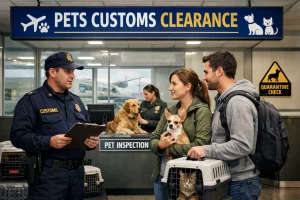
Arrival customs clearance
So you can present it fast and confidently.
Pet Travel Documents Cost (What You’re Paying For)
Vet costs vs government fees vs service fee
Your total cost usually includes:
Vet visits and vaccinations
Lab tests (if needed)
Government permits/endorsements
Our service fee for planning, support, review, and coordination
What affects pricing by country
Costs change based on:
Destination permit structure
Whether titer testing is required
Whether translations/notarisation is needed
Number of endorsements required
Extra fees to expect (tests, translations, courier, endorsements)
Possible extras:
Titer test lab fee + courier
Document translation
Notary/legalisation (some routes)
Government endorsement fees
Urgent processing (if available)
Cost breakdown table (example ranges, USD):
| Cost item | Typical range (USD) | Notes |
|---|---|---|
| Vet consultation + certificate | 50 – 300 | Depends on clinic and country |
| Rabies vaccine / boosters | 20 – 120 | Varies widely |
| Titer test (FAVN) | 150 – 400+ | Plus courier fees |
| Import/export permits | 30 – 400+ | Destination-dependent |
| Endorsements/legalisation | 20 – 200+ | If required |
| Translation/courier | 20 – 150+ | If required |
| Document support service fee | Varies | Depends on complexity |
These are general ranges. Your route decides the real total.
Common Mistakes That Delay Pet Travel
Wrong microchip format or chip not scannable
If customs can’t scan the chip, they may reject entry or request extra checks.
Rabies vaccine timing issues
Late boosters, wrong timing, or missing waiting periods cause major delays.
Certificate validity expired before arrival
If the certificate expires before landing/clearance, you can face rejection or rework.
Missing permit approval
Flying without a required permit is a common reason pets get held at arrival.
Incorrect pet details (name, breed, DOB) on documents
Even small detail mismatches can cause questions, delays, and inspection holds.
FAQ : Pet Travel Documents
Microchip, rabies, health certificate, permits (if required), and any titer test results if needed.
It depends on the destination and airline—often just a few days. Timing is critical.