If you’re planning a Sweden to Australia pet relocation for a dog or cat, the big thing to know is this: Australia treats Sweden as a Group 3 (Category 3) approved country, so you must follow the Group 3 import pathway.
That pathway isn’t “quick”, even when everything goes right. However, once you understand the sequence—microchip → rabies vaccine → RNATT (rabies titre test) → 180-day wait → import permit → treatments → flight to Melbourne → Mickleham quarantine—it becomes manageable, and way less stressful.
Quick update snapshot (what most owners miss)
- Sweden is Group 3 for Australia’s cat/dog import process.
- The RNATT 180-day waiting period is mandatory (and it starts after the sample arrives at the lab).
- Dogs and cats must arrive at Melbourne International Airport (no domestic transfers).
- Quarantine is usually 30 days, but it can drop to 10 days if an official identity check happens before the RNATT blood draw.
- Import permits often take 20–40 business days, and sometimes longer.
Is Sweden approved for importing pets into Australia?
Yes—Sweden appears on Australia’s Group 3 list for cats and dogs.
So, you’ll use the official Group 3 step-by-step guides (one for dogs, one for cats) as your rulebook.
Step-by-step timeline for Sweden → Australia (realistic planning)
Australia’s process is time-driven. Therefore, planning backwards from your desired flight date helps a lot.
A simple timeline table (minimums, assuming no retests)
|
Stage |
Dogs |
Cats |
|
Identity & microchip |
Do early; identity check can reduce quarantine |
Do early; identity check can reduce quarantine |
|
Rabies vaccination |
Must stay valid from RNATT → export |
Must be vaccinated before RNATT |
|
RNATT (rabies titre test) |
≥180 days after sample arrives at lab |
RNATT required; validity rules apply |
|
Import permit |
Apply after RNATT declaration; processing varies |
Permit linked to RNATT validity |
|
Parasite treatments |
External + internal (timed) |
External + internal (timed) |
|
Flight routing |
Melbourne only; manifested cargo |
Melbourne only; manifested cargo |
|
Quarantine |
Usually 30 days; possibly 10 |
Usually 30 days; possibly 10 |
Key rule: microchip + identity comes first
Australia ties every document to the microchip number, so don’t treat this as a small step. Also, if you want the shorter quarantine, do the identity check at the right time.
Dogs: optional identity check (reduces quarantine)
Australia allows an optional identity verification by the competent authority before any other pre-export preparations. This can reduce quarantine from 30 days to 10 days.
Importantly, the identity check cannot happen at the same vet visit as the RNATT blood draw.
Cats: same idea
Cats also can drop from 30 days to 10 days with an official identity verification before the RNATT blood sampling.
Rabies rules update: RNATT is the gatekeeper
For both dogs and cats, Australia requires:
- RNATT done using FAVN or RFFIT
- An acceptable result of 0.5 IU/ml or more
- RNATT validity generally 12 months (365 days) from blood sampling
The 180-day waiting period (and what “starts the clock”)
For dogs, Australia states clearly: your dog can’t be exported for at least 180 days after the RNATT sample arrives at the laboratory—and there are no exceptions.
So, if your vet draws blood on Monday but the lab receives it Friday, Friday matters more than you think.
Also, if the RNATT expires, you may need retesting, and that can trigger another 180-day wait depending on timing.
Import permit: apply early, not “later”
Once you have the RNATT declaration, apply for the Australia pet import permit as soon as you can. Processing often takes 20–40 business days, and it can stretch longer in some cases.
In real life, permits + flight availability + quarantine bookings can bottleneck, so earlier is safer.
Flight routing: Melbourne only, cargo only
This part surprises many owners coming from Europe.
- Dogs must arrive directly to Melbourne International Airport and Australia does not allow domestic transfers (example: land in Sydney then fly to Melbourne).
- Cats must also arrive directly to Melbourne International Airport with no domestic transfers.
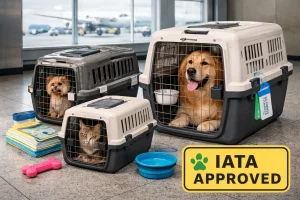
- Both must travel as manifested cargo (not in-cabin) in an IATA-approved crate.
Also, on travel day, Australia warns not to pack “extras” in the crate (toys, meds, valuables) because items may be destroyed as biosecurity waste on arrival.
Related Articles:
» Moving a Dog from the Netherlands to Norway: Crate Rules, Airline Routing, and Arrival Steps
» Pet Shipping from UAE to Spain: Documents, Timeline, and Cost Factors
» How do I prepare my pet for international relocation?
» Moving a cat from Netherlands to USA: stress reduction + paperwork checklist
» Moving a Cat from USA to Kuwait: Stress Reduction + Paperwork Checklist
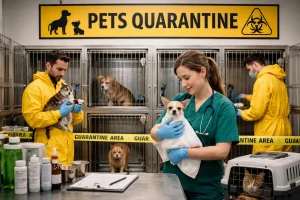
Quarantine at Mickleham (Melbourne): 30 days vs 10 days
Australia uses the Mickleham post-entry quarantine facility.
- Dogs: minimum 30 days, unless eligible for the minimum 10-day stay.
- Cats: minimum 30 days, but can reduce to at least 10 days if identity was verified before RNATT blood sampling (or if the cat originated in Australia with proper evidence).
In addition, if paperwork doesn’t match, Australia can extend quarantine and require extra actions.
Vet treatments and tests (what’s different for dogs vs cats)
Dogs: extra tests often apply
Australia lists specific dog testing and conditions in the final prep window, including:
- Leptospira canicola testing if not vaccinated
- Brucella canis testing if the dog is not desexed
- Leishmania infantum test within 45 days of export
Dogs: parasite treatments timing
- External parasites: apply a registered product which kills ticks/fleas on contact, commencing at least 30 days before export and re-apply as necessary to remain protected until export.
- Internal parasites: Treat twice at an interval of 45 days, with a treatment interval of not less than 14 and repeat the second treatment within 5 days prior to export.
Cats: parasite treatments timing (slightly different)
- External parasites: start at least 21 days before export and repeat as directed.
- Internal parasites: same structure—two treatments within 45 days, at least 14 days apart, second within 5 days before export.
Final pre-export exam and documents
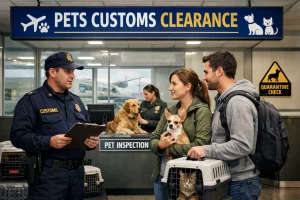
Both cats and dogs need a pre-export clinical examination within 5 days before export, and you must carry the correct original paperwork.
Australia also specifies “original/wet ink” stamping on endorsed documents (don’t show up with casual copies).
Common Sweden → Australia pet shipping mistakes (and how to avoid them)
- Starting RNATT too late: the 180-day wait is the main schedule driver.
- Skipping the identity check: you might lose the chance for 10-day quarantine.
- Microchip mismatches: even a tiny documentation mismatch can derail the process.
- Wrong flight plan: Australia requires arrival to Melbourne, and no domestic transfers.
- Treatments done outside the window: parasite timing is strict, so mark it on a calendar.
Final note: rules can change
Australia explicitly warns that import conditions can change without notice and encourages people to check for current updates and subscribe to alerts.
So, before you book flights, re-check the official guidance and your permit conditions.
FAQs: Sweden to Australia pet relocation (dogs & cats)
Most timelines exceed 6 months because of the RNATT + 180-day wait.
Yes, Sweden is placed in Group 3.
Yes — usually 30 days, sometimes 10 if eligible.
Do the official identity verification before RNATT blood sampling.
The acceptable result is ≥0.5 IU/ml and only certain test types are valid.
After the RNATT sample arrives at the laboratory (not when blood is drawn).
Yes — dogs and cats are permitted to land only at Melbourne International Airport, with no domestic transfer.
No—Australia needs physical cargo for this route
Use an IATA-approved crate and avoid placing extra items in it.
Dogs: external starts 30 days before export; cats: external starts 21 days before export. Both must receive internal treatments twice during the last 45 days.
Often yes (examples include Leptospira, Brucella canis if not desexed, and Leishmania).
Processing times are typically 20 to 40 business days, though some delays may occur.